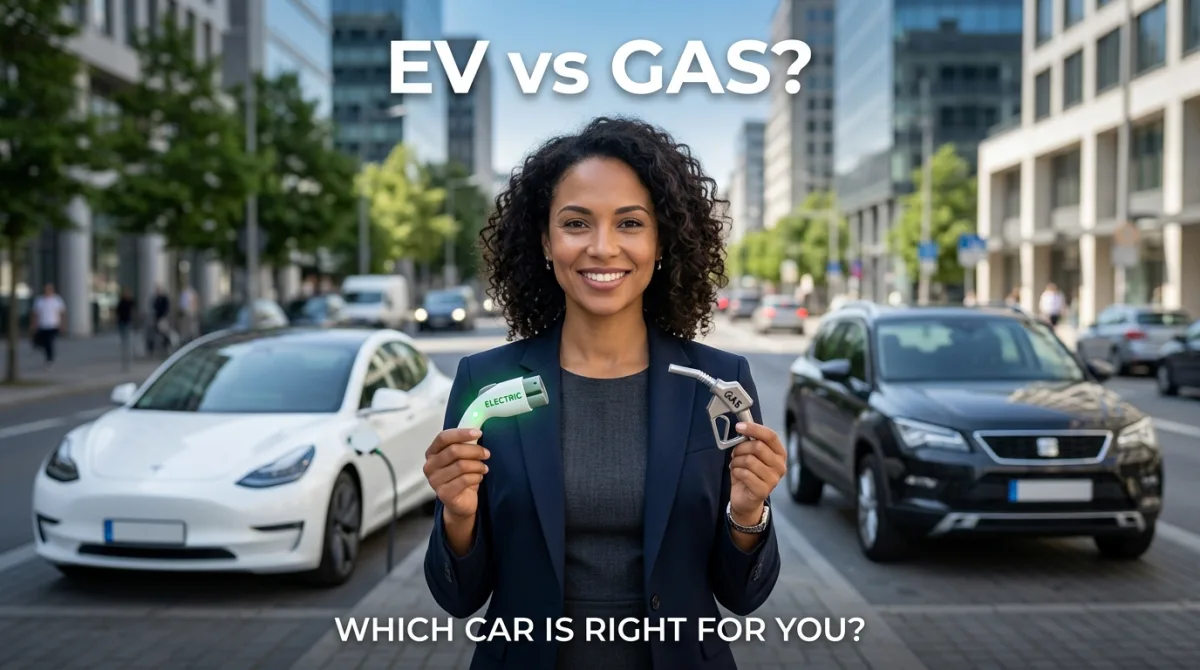
The marketing says an EV saves you thousands. The skeptics say you never get your money back. The truth, as usual, is somewhere in between — and it depends almost entirely on where you live, how far you drive, and how you charge.
We built a full 2026 cost model so you can see the real numbers. Here is the honest answer.
The real EV vs gas comparison in 2026
1. Energy cost (the biggest daily difference)
| Gas car | EV (home charging) | EV (public fast) | |
|---|---|---|---|
| Cost per 100 km | ~$11.00 | ~$3.50 | ~$6.50 |
| Cost per year (15,000 km) | ~$1,650 | ~$525 | ~$975 |
With home charging, you save roughly $1,100 per year on energy alone. Public-fast-only charging shrinks that to about $675/year.
> Tip: check your real numbers with the EV vs gas cost calculator — it uses your local electricity and fuel prices.
2. Purchase price (the upfront gap)
The average new EV still costs $3,000–$8,000 more than an equivalent gas car in 2026. That gap has narrowed every year as battery prices fall, and incentives close it further.
In the US, a $7,500 federal credit plus state rebates can make the EV cheaper than the gas car on day one. Check your EV incentives by country.
3. Maintenance (EVs win big)
Over 5 years:
- Gas car: ~$3,000+ (oil changes, belts, filters, spark plugs, exhaust)
- EV: ~$1,000 (tires, wipers, cabin filter, brake fluid)
EVs have fewer moving parts and regenerative braking wears brakes far more slowly. This is a $2,000+ saving over 5 years.
4. Insurance (EVs lose a little)
EVs cost 10–25% more to insure in most markets due to higher repair costs and expensive batteries. Expect to pay $150–$300 more per year.
5. Depreciation (varies wildly)
- New EVs: still depreciate faster than equivalent gas cars in many markets — 50% in 3 years is common for non-Tesla models
- Used EVs: the depreciation of the previous owner is your gain
- Tesla & in-demand models: hold value surprisingly well
This is the biggest hidden cost of EV ownership, and it's also the most variable. Buy used or pick a high-demand model and you can sidestep most of it.
The full 5-year picture (typical US, 15,000 km/yr, home charging)
| Cost | Gas car | EV |
|---|---|---|
| Purchase (after incentives) | $30,000 | $30,500 |
| Energy (5 yrs) | $8,250 | $2,625 |
| Maintenance (5 yrs) | $3,000 | $1,000 |
| Insurance (5 yrs) | $6,000 | $6,750 |
| Depreciation (5 yrs) | $13,500 | $15,250 |
| Total 5-year cost | $60,750 | $56,125 |
The EV saves you about $4,600 over 5 years — roughly $77/month — before accounting for the resale value of a battery that still has years of life left.
> Note: these are illustrative US numbers. Yours will differ. Run the total cost of ownership tool with your local prices for an exact figure.
When the EV loses
You need to be honest: an EV is not cheaper if you:
- Only drive short distances AND have no home charging (you pay premium public rates)
- Live somewhere with very cheap gas and very expensive electricity
- Buy a brand-new premium EV that depreciates hard
- Rarely drive at all (fixed costs dominate)
FAQ
How much money do you really save switching to an EV? For a typical driver charging at home: $600–$1,100 per year on energy, plus $400/year on maintenance, minus a small insurance premium. Net: $800–$1,300 saved per year.
Is an EV cheaper than gas in 2026? On total cost of ownership, yes for most home-charging drivers. The savings are bigger in Europe (expensive fuel) and in US states with high gas prices.
What is the cheapest EV to own? Efficiency + home charging + LFP battery = lowest running cost. A small EV like the BYD Dolphin or Hyundai Kona Electric is near the top of the value chart.
The bottom line
Yes — for most people, an EV really is cheaper to own in 2026. The savings come from cheap home electricity and low maintenance, and the biggest risk is depreciation, which you can manage by buying used or choosing high-demand models. Run the numbers for your own situation — the calculators are free — and decide with facts, not opinions.