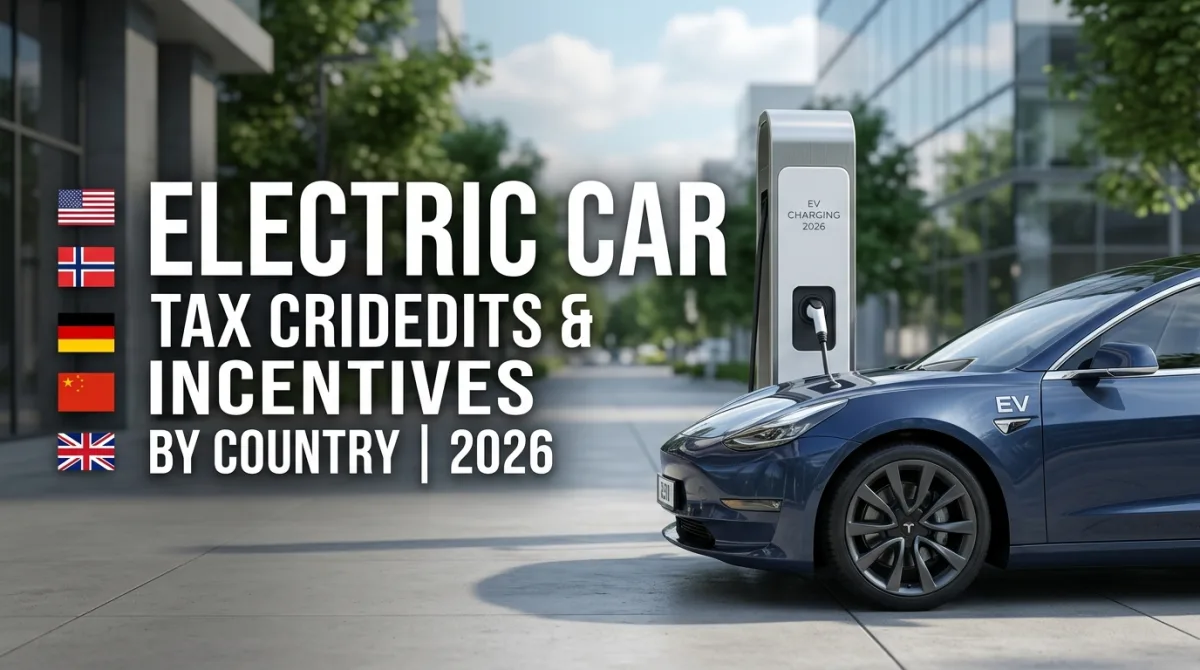
Governments are literally handing out thousands of dollars to get you into an electric car — and a shocking number of buyers never claim the full amount. In 2026, incentives are the single biggest lever you can pull to reduce the price of your next EV.
Here is the complete, up-to-date map of EV tax credits and rebates by country.
The quick overview (2026)
| Country | Main incentive | Max value | Key condition |
|---|---|---|---|
| USA | Federal tax credit (30D) | $7,500 | Price cap + battery sourcing rules |
| Canada | iZEV federal rebate | CAD $5,000 | Price cap, under CAD $55,000 |
| UK | None (phased out) | £0 | Plug-in Grant ended in 2022 |
| France | EV bonus (social leasing) | €7,000 | Income-based, low-carbon vehicles |
| Germany | Ended June 2024 | €0 | No national purchase bonus |
| Netherlands | BIK tax benefit | Tax saving | Company cars 0–4% BIK |
| Norway | VAT & toll exemptions | ~25% price cut | EV price < NOK 500,000 |
| China | Purchase tax exemption | ~10% of price | New-energy vehicles |
| Spain | MOVES III | €7,000 | Income + scrappage conditions |
> Incentives change frequently. Always verify current rules on the official site before buying.
USA: the $7,500 question
The US federal credit (up to $7,500) applies to new EVs assembled in North America, with battery mineral and component sourcing requirements that tighten every year. Key 2026 points:
- SUV price cap: $80,000 for SUVs, $55,000 for other vehicles
- Income caps: $150,000 (single), $300,000 (joint) — or $225,000/$450,000 for the "possession" rules on some vehicles
- Many states add bonus rebates (Colorado, New York, California can stack thousands more)
- Used EV credit: up to $4,000 for qualifying used EVs under $25,000
Our EV incentives tool computes your exact effective price by country and vehicle.
Europe: a patchwork of deals
- France offers a bonus up to €7,000 (income-tested) plus a social leasing program for lower-income households.
- Germany ended its national purchase bonus in 2024 — but many German manufacturers offered factory discounts that filled the gap, and some states add local support.
- Netherlands is the EV company-car heaven: low BIK rates make EVs dramatically cheaper to lease through work.
- Norway remains the world's most EV-friendly market, with VAT exemption (about 25% off) and free tolls and ferries — which is why EVs are the overwhelming majority of new cars sold there.
UK: the incentives that remain
The UK no longer offers a purchase grant, but you still get:
- 0% Vehicle Excise Duty (road tax) on new EVs for the first year (2026)
- Salary sacrifice schemes — the most powerful UK incentive, letting you lease an EV from pre-tax income
- Home charger grants in some cases (mainly apartments and landlords)
How to claim every dollar you're owed
- Check eligibility before you buy — model, price, income, assembly location
- For US federal credit: it applies at point of sale since 2024 — the dealer transfers it, you pay less immediately
- Stack programs: federal + state + local + utility incentives can overlap
- Ask about commercial incentives if you buy through a business — often bigger than personal ones
FAQ
Do EV tax credits apply to used cars? Yes in the US (up to $4,000) and in several European countries with conditions. See the best used EVs to buy.
Can I claim a credit if I lease? Often yes — and for commercial leasing the full credit is usually captured by the finance company and passed to you in a lower monthly payment.
Which country has the best EV incentives in 2026? For pure purchase-value, France's income-tested bonus and Norway's VAT exemption are among the most generous. For business buyers, the Netherlands leads.
The bottom line
A $7,500 US credit or a €7,000 French bonus can turn a "too expensive" EV into a bargain — sometimes making it cheaper than the gas equivalent on day one. Don't leave that money on the table. Check your country's rules and your exact model's eligibility with the incentives calculator before you negotiate.