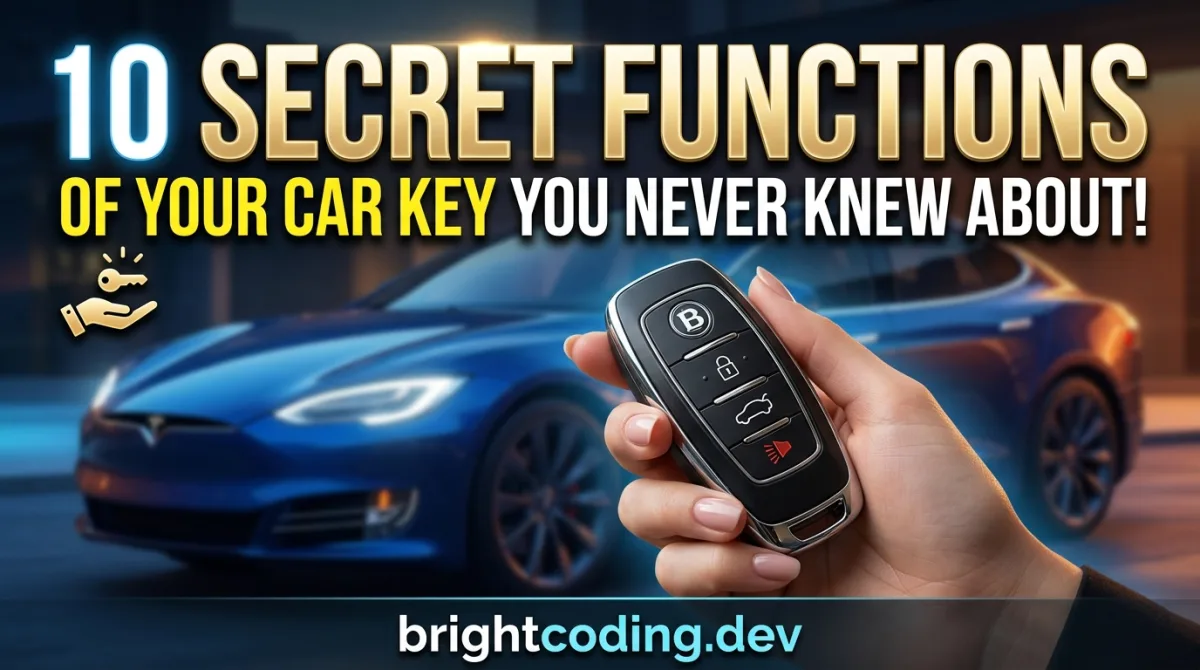
Your key fob does more than lock and unlock. Most modern remotes hide a handful of useful functions that never make it into the owner's manual, or get buried on page 214 under a heading you would never search for. Spend ten minutes with this guide and you will be able to roll your windows down from across a parking lot, find your car in a crowded garage, and stop a thief from cloning your signal at a coffee shop. You will also learn which of these tricks your car probably does not support, so you do not stand in the rain pressing buttons that do nothing.
What you need before you start
- Your key fob, plus the spare if you have one, since some features only work on the primary key.
- Your car's owner's manual. Yes, really. The exact button combinations vary by brand and model year, and guessing wastes time.
- A safe, quiet spot to test, ideally your own driveway rather than a public car park.
- No app, no account, no subscription. Everything here is built into the hardware you already own.
- A note on your phone to record which combinations work, because you will forget by next month.
One thing before we start: nothing in this guide involves opening the hood or touching the 12V battery. If a feature does not respond, do not start pulling fuses or dismantling the fob to "reset" anything. That is how people break a $200 remote. If your car has an electrical fault that shows up alongside a dead fob, our EV troubleshooting guides walk through the safe diagnostic order, and the diagnostic and fuse guides cover which circuits feed the receiver module.
1. Roll the windows down before you reach the car
Hold the unlock button for three to five seconds. On many cars built in the last fifteen years, this drops all the windows and sometimes opens the sunroof. Hold lock for the same duration and they close.
Why it matters: on a hot day you can vent the cabin before you get in, and you can close everything from your front door if you forgot. Practical tip: the feature is often disabled by default. If nothing happens, check the manual for a setting usually labelled something like "comfort opening" or "remote window control" and confirm it is switched on. Some brands require the car to be locked first, then a second long press.
2. Panic button, and why you should know where it is
Most fobs have a red button, or a button marked with a horn symbol. Press it and the car sounds the alarm and flashes the lights. Press again, or press unlock, to stop it.
Why it matters: it is genuinely useful if you feel unsafe walking to your car at night, and it is the fastest way to locate your vehicle in a multi-storey car park. Practical tip: on some remotes this is a hidden button on the back, or you trigger it by pressing lock three times. Learn which one yours is now, not when you need it.
3. The "find my car" light show
Press lock twice in quick succession. Many cars respond with a short horn chirp and a flash of the indicators. Some models flash the headlights for a few seconds instead.
Why it matters: it saves you walking three rows in the wrong direction. Practical tip: if the chirp is too loud for your neighbourhood, most cars let you switch between "horn plus lights" and "lights only". Look for a setting in the vehicle menu, often under locks or security.
4. One-press driver's door unlock
Press unlock once and only the driver's door opens. Press it twice and the rest follow. This is a deliberate safety feature, not a fault.
Why it matters: it stops someone jumping into the passenger side while you are getting in at night. Practical tip: if you would rather all doors open at once, most cars let you change this in the settings menu. On cars with a touchscreen, it is usually under something like Settings > Vehicle > Locks. On older cars it may require a sequence of key turns in the ignition, so check the manual before you try anything.
5. The hidden physical key inside the fob
There is almost certainly a metal key blade inside your remote. Press a release tab, slide the back cover off, or pry the two halves apart gently along the seam. The blade slides out.
Why it matters: when the fob battery dies, this is how you get into the car. There is usually a small cap or a covered slot on the driver's door handle that hides the mechanical lock cylinder. Practical tip: find that hidden keyhole once, in daylight, while the fob still works. Trying to find it in the dark with a dead battery is miserable.
6. Start the car with a dead fob battery
Once you are inside, you can usually still start the car. Hold the fob against the start button and press it. Many cars have an inductive reader in the button itself, or a marked pad somewhere on the console.
Why it matters: a fob battery dying is the single most common reason people think their car has an immobiliser fault. Practical tip: the exact placement matters. Common spots are directly on the start button, in the cup holder, or in a marked recess near the gear lever. Check your manual for the phrase "start with dead key battery".
7. Remote start, if your car has it
Press lock, then press and hold the remote start button, often a circular arrow symbol, for two to three seconds. The engine or climate system runs for a set period, typically around ten minutes, then shuts off.
Why it matters: it defrosts the windscreen or cools the cabin before you get in. Practical tip: many cars disable remote start if the hood is open, the battery is low, or the car was not locked properly. If it refuses to work, those are the first three things to check. Note that in an electric car this function warms or cools the cabin rather than starting an engine, and it can cost you real range, so use it sparingly on cold mornings.
8. Tailgate release and the "kick" sensor
Many fobs have a dedicated boot button. Press it twice, or press and hold, depending on the model. On cars with a hands-free tailgate, a key in your pocket plus a kick under the rear bumper opens it.
Why it matters: it saves putting your shopping down. Practical tip: the kick sensor is fussy. A deliberate forward kick and step back works better than a sweep. If yours never triggers, the sensor may be disabled in the menu or the fob battery may be getting weak.
9. Memory seats and mirror positions tied to the key
On cars with memory seats, each fob can be linked to a seat, mirror and steering wheel position. Unlock with fob one and the car moves to your settings. Unlock with fob two and it moves to your partner's.
Why it matters: if two people share the car, this ends the daily readjustment ritual. Practical tip: the linking procedure varies a lot. Some cars do it automatically based on which fob unlocked the car last, others need you to hold a memory button while pressing unlock. It is worth ten minutes with the manual.
10. Stop your key being cloned
This one is not a button, it is a habit. Relay attacks, where thieves amplify your fob's signal from outside your house to a receiver near your car, are a real and growing problem. So is keyless entry in general.
Why it matters: a car that unlocks itself in the driveway at 3am is not haunted, it is being targeted. Practical tip: keep fobs in a metal tin, a signal-blocking pouch, or simply far from the front door, ideally in a room well away from where the car is parked. Some fobs can have their motion sensor sleep mode enabled so they stop transmitting when stationary. Check whether your model supports it, and if you are shopping for a car and this matters to you, compare how different models handle keyless security in our head-to-head EV comparisons.
Pro tips
- Test one feature at a time and note the result. Chasing five buttons at once just creates confusion.
- Replace the fob battery every two to three years, or the moment range starts dropping. It is a cheap coin cell in most remotes and takes two minutes.
- Buy the correct cell type. Check the old battery, not the internet. Wrong-size cells cause poor contact and intermittent faults.
- If you have two cars from the same brand, do not assume the button combinations match. Model year matters more than badge.
- Keep the spare fob's battery out if you store it for years. Leaking cells destroy remotes.
- If you are comparing a used EV and the seller cannot demonstrate these functions working, treat a dead fob or a non-responsive receiver as a bargaining point, not a dealbreaker.
Common pitfalls
- Assuming your car has the feature. Plenty of cars, especially older or base-trim models, have none of the window or remote-start tricks. No amount of button mashing will add hardware that is not there.
- Holding the button too briefly. Most long-press features need a genuine three to five seconds. Count it out.
- Pressing the panic button by accident. On some fobs it sits right next to lock. If your alarm keeps going off, check your pocket.
- Prying the fob open with a screwdriver. You will crack the casing and possibly damage the antenna. Use the release tab or a plastic trim tool, and go slowly.
- Ignoring a weak fob and blaming the car. If range drops to a metre or two, replace the battery before you start suspecting the receiver module or the car's wiring.
Useful resources
If you are working out how much a feature actually costs you in running terms, for example remote cabin pre-conditioning on an EV, the free EV calculators and tools on this site will give you a realistic number rather than a guess. If you are still choosing between models and want to know which ones include these conveniences as standard, start with the EV model directory and filter from there. For anything electrical that goes beyond a fob battery, the EV blog has plain-English explainers, and your manufacturer's owner's manual remains the only source that is guaranteed correct for your exact car.
FAQ
Why does my key fob only work when I am right next to the car? Nine times out of ten it is a failing battery. Replace it first. If a fresh cell does not help, the fob may have been damaged by a drop or water, or the car's receiver antenna may have an issue.
Can I add remote window control to a car that does not have it? Usually not without aftermarket hardware, and fitting that can affect your warranty and your insurance. Check with a dealer or a reputable auto electrician before buying anything.
Is it safe to use a signal-blocking pouch? Yes, and it is a sensible habit if your car has keyless entry. Just make sure you can still unlock the car when you want to. Test it once so you are not locked out of your own vehicle.
Do these tricks work on electric cars? Most of them do, since the fob hardware is shared across petrol, diesel and electric models. Remote start becomes climate pre-conditioning, and that draws from the traction battery, so it does reduce range slightly.
My fob stopped working entirely after I tried one of these. What now? Stop. Do not open the fob, do not disconnect the car battery, and do not start pulling fuses. A fob that no longer responds at all may need reprogramming, which is a dealer or locksmith job. Book it in.
One last thing
Pick two features from this list and test them this week, while the sun is out and you are not in a hurry. Knowing your key properly is one of those small skills that pays off in exactly the moment you least want to be figuring it out.