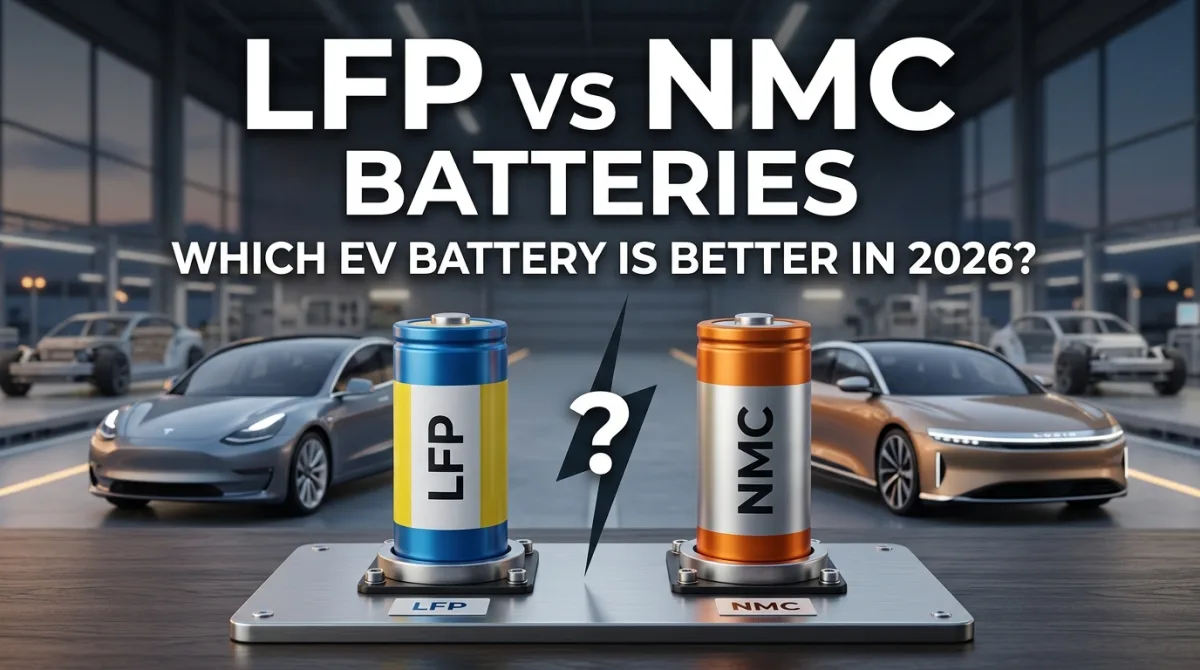
The battery is the heart of your EV — and in 2026 there are two very different kinds of heart you can choose: LFP and NMC. The chemistry you pick affects price, range, longevity, cold-weather behavior and charging speed.
Here's the honest LFP vs NMC comparison, so you can choose right for your driving.
LFP vs NMC at a glance
| LFP (Lithium Iron Phosphate) | NMC (Nickel Manganese Cobalt) | |
|---|---|---|
| Cost | Cheaper (no cobalt, more abundant) | More expensive |
| Energy density | Lower (heavier, bigger pack) | Higher (more range per kg) |
| Cycle life | 2,000–4,000 cycles | 1,000–1,500 cycles |
| Calendar aging | Slower | Faster |
| Charge to 100% daily | Fine (safe) | Not ideal (wear) |
| Cold weather | Worse range loss | Better cold tolerance |
| Safety | Very stable, hard to ignite | Less stable, more reactive |
| Fast charging | Slower peak, but full 10–80% often similar | Higher peak speeds |
The 2026 market reality
The industry is splitting cleanly along price lines:
- Budget and mid-range cars (Chevy Equinox EV, BYD models, MG4, Citroën ë-C3, Volvo EX30) → LFP
- Premium and performance cars (BMW i4, Porsche, Mercedes EQE, Lucid) → NMC
- Some brands hedge — offering LFP on standard-range trims and NMC on long-range versions
This is why EV prices finally fell: LFP slashed pack costs, especially after its tax credit implications in the US made affordable EVs even cheaper.
Which is better for you?
Choose LFP if you...
- Care about total cost and long-term durability
- Charge at home daily and want a 100% charge habit without worry
- Live in a mild or cold-ish climate (LFP cold loss is manageable)
- Keep cars long-term (LFP's cycle life wins over a decade)
- Do mostly city and commuting driving
Choose NMC if you...
- Need maximum range in the least space and weight
- Fast charge frequently at public chargers (NMC peaks higher)
- Live in a very hot or very cold climate
- Do long road trips regularly
- Prefer performance cars (NMC supports higher discharge)
The "charge to 100%" question
This is the biggest practical difference. LFP batteries can be charged to 100% daily with minimal degradation — manufacturers explicitly recommend it. NMC batteries prefer an 80% daily limit and full charges only before trips.
If you have home charging and want zero thought about charge limits, LFP wins on convenience alone.
Cold weather: the honest comparison
Both lose range in winter. LFP loses more (up to 5–10% extra) because low temperatures slow its chemistry more. But LFP degradation from heat is far lower. Net: NMC is slightly better in extreme cold, LFP is better in heat and over time.
Use the winter range calculator to see what your choice means in your climate.
FAQ
Is LFP better than NMC? For most buyers in 2026 — yes. Cheaper, safer, longer-lasting, and you can charge to 100% daily. NMC's advantages (range density, cold, fast-charge peak) matter mainly for premium/performance buyers.
Do all EVs use LFP now? No. It's the standard in budget/mid-range models, but premium and long-range models still use NMC or NCA for range density.
Which battery lasts longer? LFP, by a wide margin — roughly 2x the cycle life and slower calendar aging. See how EV batteries degrade.
The bottom line
In 2026, LFP is the smart choice for the majority of EV buyers — cheaper, safer, more durable, and free from the "don't charge to 100%" rule. NMC remains the right call for long-range, cold-climate, fast-charging and performance buyers. Match the chemistry to your driving, not the marketing.