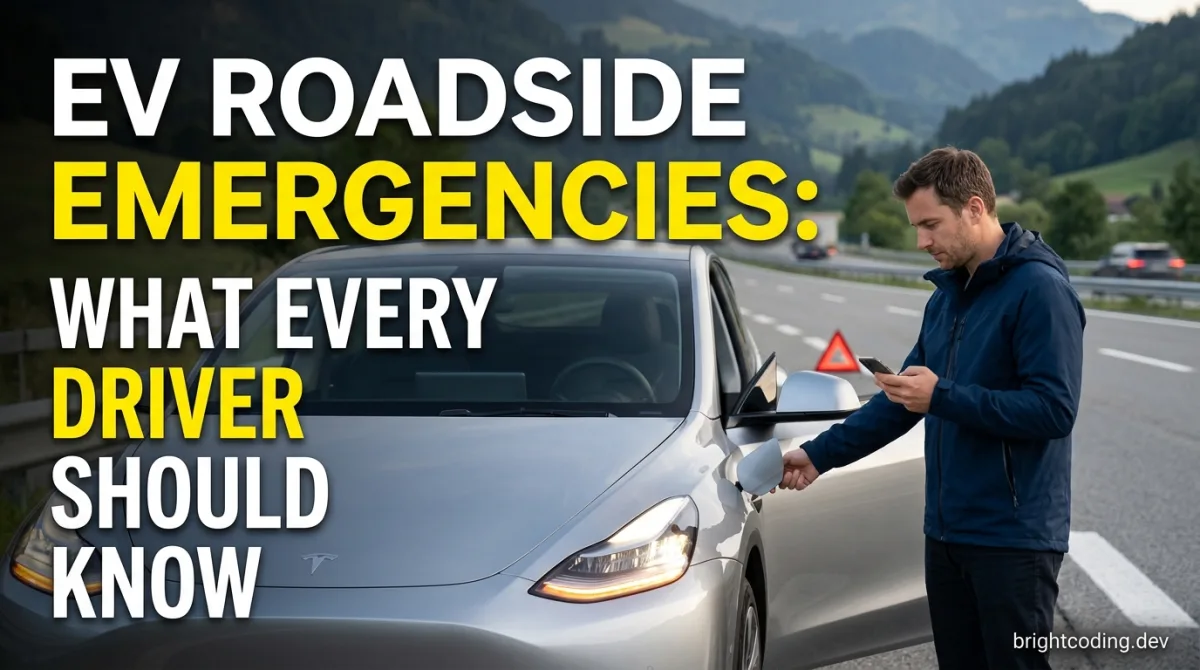
You are 40 miles from home, the dashboard throws a warning, and the car starts slowing down on its own. Or maybe you are standing next to a scooter that simply will not move, and you have no idea whether to call a tow, a friend, or just push it home. That sinking feeling is the same whether you drive a Model 3, a Nissan Leaf, or ride a 50cc-equivalent electric moped.
EV roadside emergencies are different from petrol-car breakdowns, and most drivers find that out the hard way. This guide walks you through what actually happens, why it happens, and exactly what to do in the first ten minutes. By the end you will know when you can fix it yourself and when you must stop and call a professional.
The Problem: You Cannot Jump an EV the Way You Think
The biggest misconception is that an electric car is "just a car with a big battery." It is not. A petrol car that runs out of fuel needs a can of petrol. An EV that runs out of charge needs a charger, a tow, or in rare cases a mobile charging unit. Those are three very different phone calls.
Most EV owners have never read the emergency section of their manual. That is normal. But it means that when the moment comes, they make predictable mistakes: they keep driving on a low-charge warning hoping to reach the next charger, they try to jump-start the traction battery, or they call a generic tow company that does not know how to flatbed an EV safely without damaging the underside.
The stakes are real. A flat battery is annoying. A flat battery combined with a steep hill, an active high-voltage fault, or a car that refuses to shift into neutral is a safety situation. Knowing the difference matters.
Why EV Roadside Calls Happen: The Four Real Causes
Most EV breakdowns fall into four buckets, and each needs a different response.
1. The battery is genuinely empty or nearly empty. This is the most common. Cold weather, headwinds, heating, and highway speeds can all cut your real-world range well below the brochure number. If you planned a 200-mile trip on a car rated for 220 miles, in winter, you were already gambling.
2. The 12V auxiliary battery has died. Yes, EVs have a small 12V battery, and yes, it can fail just like in a petrol car. When it dies, the car may not power on, the doors may not unlock remotely, and the screens stay black. This is the single most misunderstood fault in EV ownership. The traction battery can be at 70% and the car still will not start.
3. A safety system has locked the car into limp mode. High-voltage faults, coolant issues, or a charger that failed mid-session can trigger a protective shutdown. The car may crawl, refuse to shift, or display a red warning. This is the car protecting itself, and it usually means you should not force it.
4. A physical problem: a puncture, a damaged charge port, a seized brake, or a scooter controller that has cut out. These are not EV-specific but they strand you the same way.
If you are not sure which one you are facing, our EV troubleshooting guides break down symptom-by-symptom what each warning usually means.
Your Options When You Are Stranded
Here is the honest menu. None of these is universally best. The right one depends on your battery level, your location, your car, and whether a fault light is on.
Option 1: Mobile charging (for a genuinely empty battery)
What it is: A van or truck that brings a charger to you and gives you enough range to reach a real charging station.
How it works: You call your manufacturer's roadside line or a specialist provider. They arrive, plug in, and typically give you 10-30 miles of range. Enough to limp to a charger, not enough to finish your trip.
Advantages: Cheapest option if you are in a covered area, no tow needed, no risk to the car.
Disadvantages: Not available everywhere, can take hours, and some providers charge a per-mile or flat callout fee.
When it makes sense: You ran out of charge on a normal road, the car powers on, and you are within range of coverage. Verify your provider covers your area before you rely on it.
Option 2: Flatbed tow to a charger or dealer
What it is: The standard recovery method when the car cannot or should not move under its own power.
How it works: An EV must be towed on a flatbed or with all four wheels off the ground. Towing with two wheels down can damage the motor and drivetrain on many models.
Advantages: Works everywhere, handles faults, punctures, and dead 12V batteries.
Disadvantages: Costs money if you are out of warranty or outside your recovery package, and you need a company that knows EVs.
When it makes sense: Any time a red warning is active, the car will not shift, or the 12V battery is dead.
Option 3: The 12V jump (only for the auxiliary battery)
What it is: Jump-starting the small 12V battery, exactly like a petrol car, to wake up the electronics.
How it works: You connect a jump pack or donor car to the 12V terminals, following your manual's specific procedure. Many EVs have a dedicated jump point under a plastic cover, not directly on the battery.
Advantages: Can get you moving in minutes if the 12V battery is the only problem.
Disadvantages: If the traction battery is dead, jumping the 12V will not help. And if you connect to the wrong terminals, you can damage expensive electronics.
When it makes sense: The car is completely dead, the traction battery shows charge, and you can find the correct jump points in your manual.
Option 4: Fix it yourself for small EVs
For e-bikes, scooters, and mopeds, many roadside situations are genuinely DIY. A blown fuse, a disconnected brake safety switch, or a controller that has overheated can often be diagnosed on the spot. Our EV diagnostic and fuse guides walk through the low-voltage checks that are safe for a careful owner, and they make clear where you should stop.
The Best Choice Depends on Three Questions
There is no single best answer, and anyone who tells you otherwise has not been stranded at 11pm. Ask yourself three things.
| Situation | Battery level | Warning light? | Best first move |
|---|---|---|---|
| Ran out of charge, car powers on | 0-5% | None or amber | Call mobile charging |
| Car will not power on at all | Unknown | None, screens dead | Check 12V, then call for a jump or flatbed |
| Red high-voltage warning | Any | Red | Stop safely, do not drive, call a flatbed |
| Car will not shift out of park | Any | Amber or red | Do not force it, call a professional |
| Scooter or e-bike dead on the road | Low or unknown | Varies | Safe low-voltage checks, then transport home |
A quick way to reduce your risk before any trip is to know your car's realistic range, not the advertised figure. Our free EV calculators and tools let you plug in temperature, speed, and load to get a more honest estimate.
If you are still choosing a car and want to know which models handle cold weather, charging speed, and recovery best, the head-to-head EV comparisons and the full EV model directory are worth a look before you buy.
Step-by-Step Action Plan When It Happens
-
Get safe first. Indicate, pull as far off the road as you can, hazard lights on. If you are on a motorway or highway, exit the vehicle on the side away from traffic and stand behind the barrier.
-
Note exactly what the car is telling you. Warning colour, any message text, whether the car still powers on, whether it will shift into neutral. Take a photo of the dashboard.
-
Do not keep driving on a red warning. Limp mode exists to protect the battery and motor. Forcing it can turn a recoverable fault into an expensive one.
-
Check the 12V situation if the car is completely dead. If screens are black but the traction battery has charge, a 12V jump may solve it. Follow your manual's exact jump procedure. Never touch the high-voltage orange cables.
-
Call the right number. Manufacturer roadside assistance first if you are in warranty. Otherwise a recovery company that explicitly handles EVs and uses a flatbed.
-
Tell them the truth. Say it is an EV, give the battery percentage if known, and describe any warning light. This decides whether they send a charger or a flatbed.
-
Do not let anyone tow you with two wheels down. If the operator suggests it, politely refuse and ask for a flatbed. You are allowed to say no.
-
Stay with the vehicle if it is safe, or wait in a safe place. Do not sit in a car stranded in a live traffic lane.
Common Mistakes to Avoid
- Driving past the low-charge warning. Fix: treat 10-15% as your personal "find a charger now" line, not 0%.
- Trying to jump the traction battery. Fix: only the small 12V battery is jumpable. The high-voltage pack is a professional-only job, always.
- Calling a generic tow firm without asking about EV experience. Fix: confirm "flatbed" and "EV trained" on the call, not on arrival.
- Ignoring the 12V battery until it strands you. Fix: replace it on schedule, typically every 3-5 years; check your manual.
- Assuming advertised range is real range. Fix: use a range calculator and subtract 20-30% for cold or highway driving.
- Forcing a car in limp mode to keep driving. Fix: pull over, note the warning, call for help.
- Leaving the hazard lights on for hours with a dead 12V. Fix: if you can, turn them off once you are safely off the road and help is coming.
Expert Takeaway
The single most important lesson is this: separate the 12V problem from the traction battery problem, because they need completely different responses. A dead 12V battery is a cheap, quick fix you might handle yourself. A high-voltage fault or a genuinely empty traction battery is a call to a professional with the right equipment. Get that distinction right and you will handle almost any EV roadside emergency calmly, safely, and without damaging your car.
FAQ
Can you jump-start an electric car? You can jump-start the small 12V auxiliary battery, following your manual's specific procedure. You cannot and must not jump-start the high-voltage traction battery. That is a professional-only task.
What happens if an EV runs out of charge on the road? The car will slow and eventually stop. You will need mobile charging to get enough range to reach a charger, or a flatbed tow if charging is unavailable. Do not keep driving once power is critically low.
Is it safe to tow an EV? Only on a flatbed or with all four wheels off the ground. Two-wheel-down towing can damage the motor and drivetrain on many models. Always confirm the recovery company has EV experience.
Why did my EV die with charge left on the battery? The most likely cause is a failed 12V auxiliary battery. The traction pack can be healthy while the small battery that powers the electronics is dead, leaving the car completely unresponsive.
Do EV roadside assistance packages cover running out of charge? Many manufacturer and third-party packages do, but coverage varies widely by provider and region. Check your policy before you need it, not during the emergency.