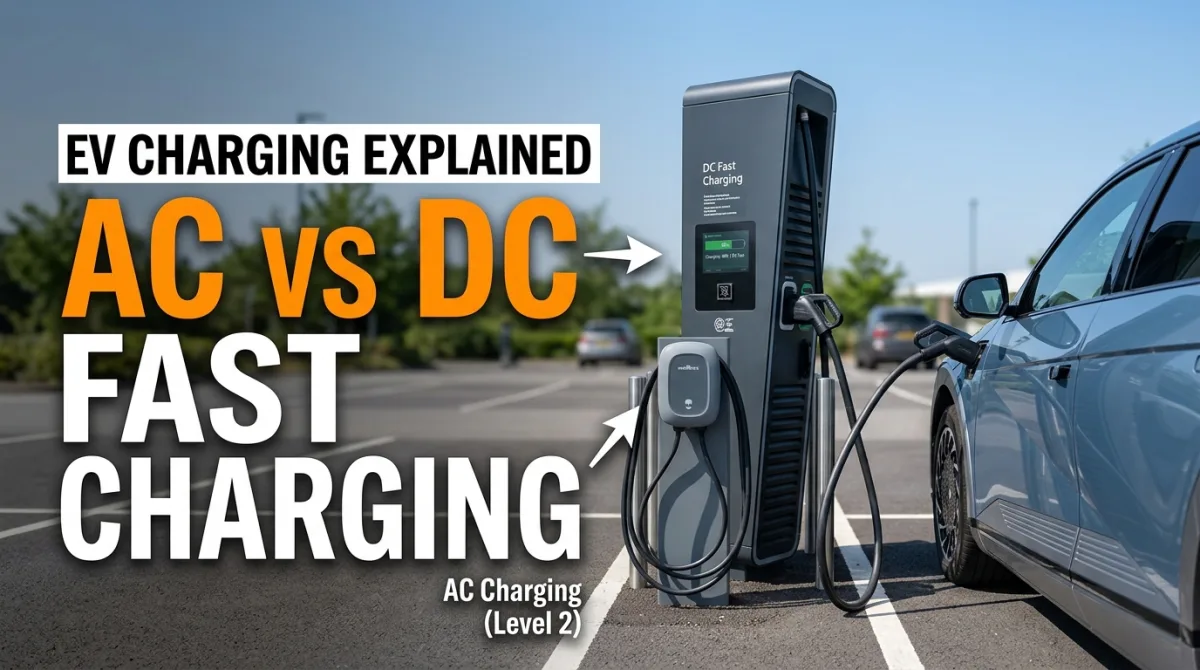
AC and DC are the two halves of EV charging, and they couldn't be more different. Understanding the difference answers half the questions new EV owners ask: why home charging is slow, why public "fast" charging is fast, and why some chargers are shaped differently.
Here's EV charging explained in plain English.
The 30-second version
- AC charging (home wallbox, most public chargers) — the charger sends alternating current to the car, and the car's onboard converter turns it into DC to fill the battery. Slow but cheap.
- DC fast charging (the big cabinets at service stations) — the charger converts AC to DC outside the car and pumps DC straight into the battery. Fast but pricey.
The difference is simply where the conversion happens — in the car (AC) or in the charger (DC).
Why DC is so much faster
The car's onboard charger (AC converter) is limited by size, cost and cooling. Typical limits:
| Charging type | Typical power | Why |
|---|---|---|
| AC, home wallbox | 7–11 kW | Small onboard converter |
| AC, public | 22–43 kW | Larger onboard converters (rare) |
| DC fast | 50–350 kW | Big external converter, heavy cooling |
A DC fast charger bypasses the car's small converter entirely, feeding the battery directly — which is why it can push 10–50x more power.
The different connectors (2026)
| Connector | Region | Charging | Notes |
|---|---|---|---|
| Type 2 / Mennekes | Europe | AC only | Standard home/wallbox plug |
| CCS2 | Europe | AC + DC | Most fast chargers; the standard |
| CCS1 | North America | AC + DC | Pre-NACS standard |
| NACS (J3400) | North America | AC + DC | Tesla's connector, now standard |
| CHAdeMO | Japan | DC | Fading out |
| GB/T | China | AC + DC | Chinese standard |
In 2026, Europe has effectively settled on CCS2, and North America is migrating to NACS. Tesla's network gives its owners an edge, but open networks are catching up.
How each charging type fits your life
AC charging — for home and destinations
- Charge overnight at home (7kW → full in ~6 hours)
- Charge while you shop or work at destination chargers (11–22kW)
- Always the cheapest option — see home charging costs
DC fast charging — for road trips
- Add 150+ miles in 15–20 minutes at a 150kW+ charger
- Used for long journeys where you can't wait overnight
- Costs 3–5x more per kWh than home charging
The charging curve (why "10 to 80" is the rule)
DC fast charging isn't constant — it's a curve:
- Low battery (10–50%): maximum speed
- Mid (50–80%): tapering power
- High (80–100%): very slow (battery protection)
This is why "charge to 80%" is the golden rule on road trips. The last 20% takes as long as the first 70%. See how long it takes to charge 10→80%.
Which should you use?
| Situation | Best choice |
|---|---|
| At home overnight | AC (wallbox) |
| At work/shop | AC (destination) |
| Road trip | DC fast |
| Emergency top-up | DC fast or AC, whichever's nearest |
The rule of thumb: AC for daily life, DC for road trips.
FAQ
Why is home charging so slow but public charging fast? Home AC chargers rely on the car's small onboard converter (7–11kW). DC fast chargers convert power outside the car and feed the battery directly at 50–350kW.
Can I only use DC fast charging? You can, but it's expensive (3–5x home rates) and slightly harder on the battery. Home AC is the recommended daily routine.
What's the difference between a home charger and a "fast charger"? Home chargers deliver AC at 7–11kW over hours. Fast chargers deliver DC at 50–350kW over minutes. Different technology, different price, different use case.
The bottom line
AC charging is your everyday fuel — cheap, slow, done overnight. DC fast charging is your road-trip fuel — expensive, fast, done in minutes. Master that split, and EV charging becomes simple. For deeper numbers, use the AC vs DC calculator and the charging cost tool.