Your dashboard just went dark on the shoulder of a highway. Or your electric car has been sitting in the garage for three months and now it will not wake up at all. Either way, you are staring at a two-tonne brick and wondering whether a tow truck is about to make things much worse.
Short answer: yes, an electric car with a dead battery can be towed, but how you tow it matters. Get it wrong and you can damage the drive motors, the inverter or the battery pack itself. That damage is not cheap to fix.
This is the part most owners only learn when it is too late. So let us walk through what actually happens, what your options are, and the exact order of steps to take.
The Problem: A Dead EV Is Not a Dead Petrol Car
A petrol car with an empty tank rolls freely. You put it in neutral, hook it up, and off it goes. An electric car is different in one crucial way: the wheels are connected to electric motors, and those motors are connected to a high-voltage battery.
When the wheels turn, they can push current back into the system. That is regen braking when you are driving normally. When you are being towed with the car off, that same energy has nowhere safe to go.
The common mistakes are predictable. Owners assume neutral means "safe to tow." Owners let a friendly stranger with a tow rope try to pull them. Owners try to jump-start the high-voltage pack like it is a 12V battery. All three can end with a repair bill in the thousands.
Why It Happens: Two Very Different "Dead Batteries"
Here is the distinction that solves most of the confusion. Your EV has two batteries.
The 12V auxiliary battery runs the computers, lights, door locks and the contactors that connect the main pack. If this one dies, the car acts completely dead even though the big battery might be nearly full.
The high-voltage traction battery is the one that moves the car. If this is flat, the car genuinely has no energy to drive.
Why does this matter for towing? Because a surprising number of "dead EV" roadside calls are actually a flat 12V battery. A jump pack on the 12V terminals can bring the whole car back to life in minutes. That is a job a careful owner can attempt. Anything involving the orange high-voltage cables is not.
The second reason towing is tricky: many EVs cannot be flat-towed or dolly-towed at all. Some can only be moved on a flatbed. Some require a specific "transport mode" or the parking brake released through a service menu. If you skip that step, you may be dragging locked wheels.
The Solutions: Your Realistic Options
1. Try a 12V jump first
Before you call anyone, check whether it is just the small battery. If the car is totally unresponsive but you can reach the 12V terminals, a jump pack or jumper cables from another car can restore the computers. If the car powers up and shows charge in the main pack, you may just drive away.
Advantage: free or nearly free, fast. Disadvantage: it will not help if the traction battery is genuinely empty. Cost: nothing, or the price of a jump pack.
If the car wakes up but throws warnings, our EV troubleshooting guides walk through the most common fault patterns.
2. Flatbed tow truck
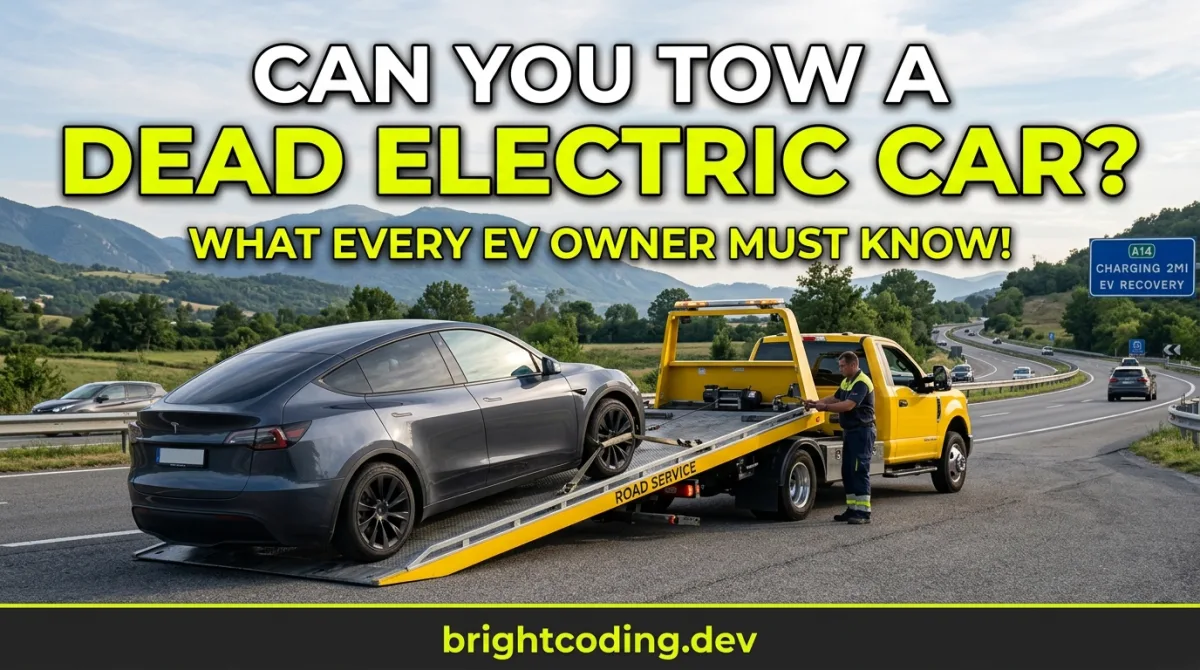
This is the default safe answer for a fully dead EV. The car goes on a tilting flatbed with all four wheels off the ground. No wheels spin, so no unwanted current is generated and no drivetrain parts wear.
Advantage: works for essentially every EV regardless of drivetrain layout. Disadvantage: costs more than a hook-and-chain tow, and you may wait longer. Typical roadside or recovery cost varies widely by country and distance, so check your policy rather than trusting a number from the internet.
3. Dolly tow (two wheels up)
Some EVs can be towed with the driven wheels lifted on a dolly. This only works if the non-driven wheels can roll freely and the manufacturer permits it. Many modern EVs with motors on both axles cannot be dolly-towed at all.
Advantage: sometimes cheaper and easier to arrange. Disadvantage: easy to get wrong, and getting it wrong can spin a motor that should be still.
4. Rope or chain tow
Do not do this with an EV. A tow rope means the wheels turn while the car is off, and that can feed current back into a system that is not designed to receive it in that state. Use this only as a last resort to move the car a few metres out of a live lane, and only if there is genuinely no alternative.
5. Mobile charging instead of towing
If the car has a little charge left and simply ran out, a mobile charging van may be able to add enough range to reach a charger. This is often cheaper and faster than a tow, but availability depends heavily on where you live.
If you are weighing up which EV is less likely to strand you in the first place, the EV model directory lets you filter by range and charging speed, and the head-to-head comparisons show how real models stack up.
The Best Choice: It Depends on Your Situation
| Situation | Best option | Why |
|---|---|---|
| Car totally dead, 12V suspected | Jump the 12V first | Often revives the car, no tow needed |
| Traction battery empty, car rolls | Mobile charging van | Cheaper than recovery if available |
| Traction battery empty, no mobile charging | Flatbed tow | Safest for all drivetrains |
| All-wheel-drive EV, any fault | Flatbed tow | Dolly towing usually not permitted |
| Car in a live lane | Emergency services first, then flatbed | Safety beats saving money |
| Minor fault, car still drives | Drive slowly to a charger or dealer | Avoids tow cost entirely |
Verdict: if you are unsure, choose the flatbed. It costs more, but it is the option least likely to create a second, larger problem. Choose a jump start only when you have confirmed the fault is the 12V battery. Choose dolly towing only if your manufacturer's manual explicitly allows it, and never assume.
Step-by-Step Action Plan
- Get safe first. Hazard lights on, passengers behind the barrier, warning triangle out if you have one. On a live road, call emergency services before anyone else.
- Check whether it is the 12V battery. If interior lights and the dash are completely dead but the car was recently charged, suspect the small battery.
- Try a 12V jump if you can do it safely. Red to positive, black to negative or a ground point, then start. Never touch the orange high-voltage cables.
- If it starts and shows range, drive to a charger. Keep an eye on warnings.
- If it does not start, stop. Do not keep cranking or experimenting.
- Call roadside assistance and tell them it is an EV. Say the words "flatbed required" and mention if it is all-wheel drive.
- Find the manual's towing section. Look for transport mode, parking brake release, or a stated towing restriction.
- Confirm the tow method before the truck arrives. Ask the operator directly whether they are bringing a flatbed.
- Photograph the car before and after. Useful if any damage occurs.
- After the tow, get the root cause checked. A repeated flat 12V battery often points to a charging or DC-DC converter fault.
If you want to understand what your car is telling you before you call anyone, the EV diagnostic and fuse guides are a good next read.
Common Mistakes to Avoid
- Flat-towing with all four wheels down. Fix: insist on a flatbed unless the manual says otherwise.
- Assuming "neutral" means safe. Fix: check the manual for a transport mode first.
- Jump-starting the high-voltage pack. Fix: only ever jump the 12V battery, and never touch orange cables.
- Letting a stranger rope-tow you at speed. Fix: use a rope only to clear a live lane, never for distance.
- Not telling the recovery company it is an EV. Fix: say "electric vehicle, flatbed required" when you call.
- Ignoring a recurring flat 12V battery. Fix: get the charging system checked, because it will strand you again.
- Towing to the nearest garage rather than an EV-capable one. Fix: confirm the destination can actually work on your car.
Expert Takeaway
The single most important lesson: a dead EV is usually a towing problem, not a driving problem. The car itself is rarely broken. What breaks it is the wrong tow method. Confirm the 12V battery first, demand a flatbed when in doubt, and never let anyone spin your wheels while the car is off.
FAQ
Can you tow an electric car with a dead battery? Yes, but normally only on a flatbed. Towing with the wheels on the ground can push current back into the drivetrain and cause damage, so check your manual before agreeing to any other method.
Can you jump-start an electric car? You can jump the 12V auxiliary battery, which often brings the car back to life. You cannot jump-start the high-voltage traction battery, and you should never touch the orange cables.
Does towing an EV charge it? In theory the motors can generate current when the wheels turn, but the car has to be awake and in the right mode for that to be safe. When it is dead, that energy has nowhere useful to go, which is why flat-towing is risky.
Will roadside assistance tow my electric car? Most providers will, and many now send flatbeds for EVs as standard. Tell them it is electric and all-wheel drive when you call, and confirm the truck type before it arrives.
How much does it cost to tow a dead EV? It depends on your country, distance and whether you have breakdown cover. Costs can range from free under a policy to a significant fee for long-distance recovery, so check your cover rather than guessing.
Should I tow my EV to a dealer or a normal garage? Prefer a dealer or a workshop that explicitly handles EVs. A general garage may not have the tooling or training for high-voltage work, which can slow the repair down.