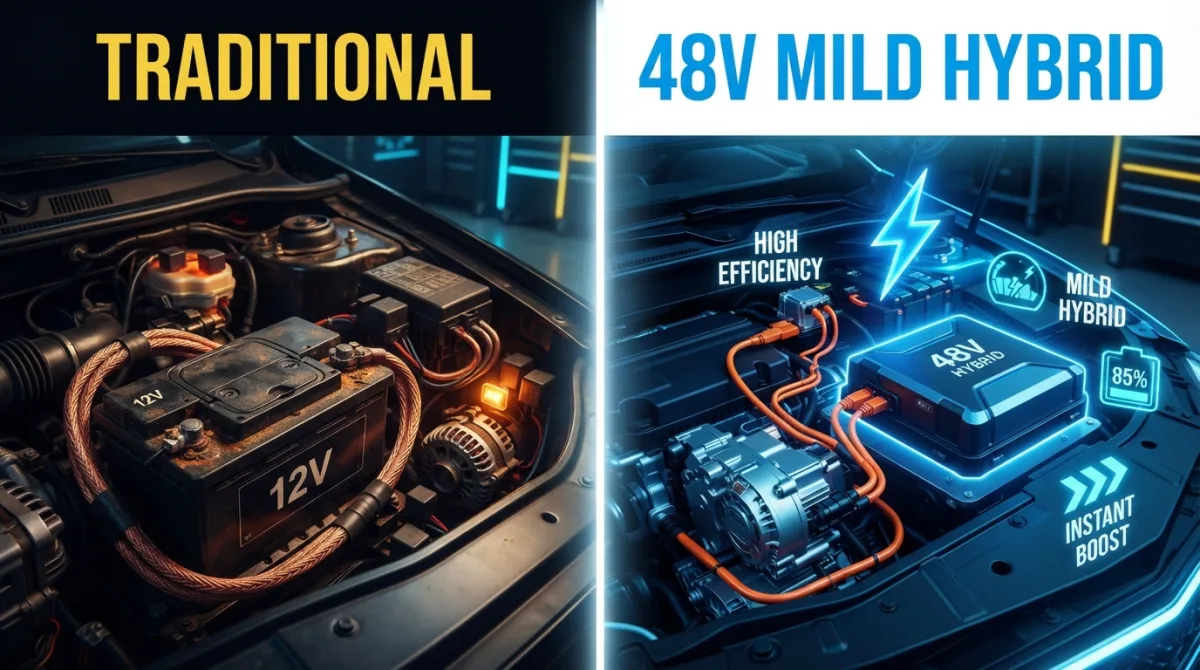
Quick pitch: Your car’s electrical system is about to get its biggest glow-up since the 1950s. We’re talking about the jump from 12 volts to 48 volts, a change that sounds small but delivers massive wins in power, efficiency, and even safety. Here’s the friendly, no-fluff guide to why 48V is stealing the spotlight (and why your trusty 12V isn’t going anywhere just yet).
First, Why Do We Even Have a 12V System?
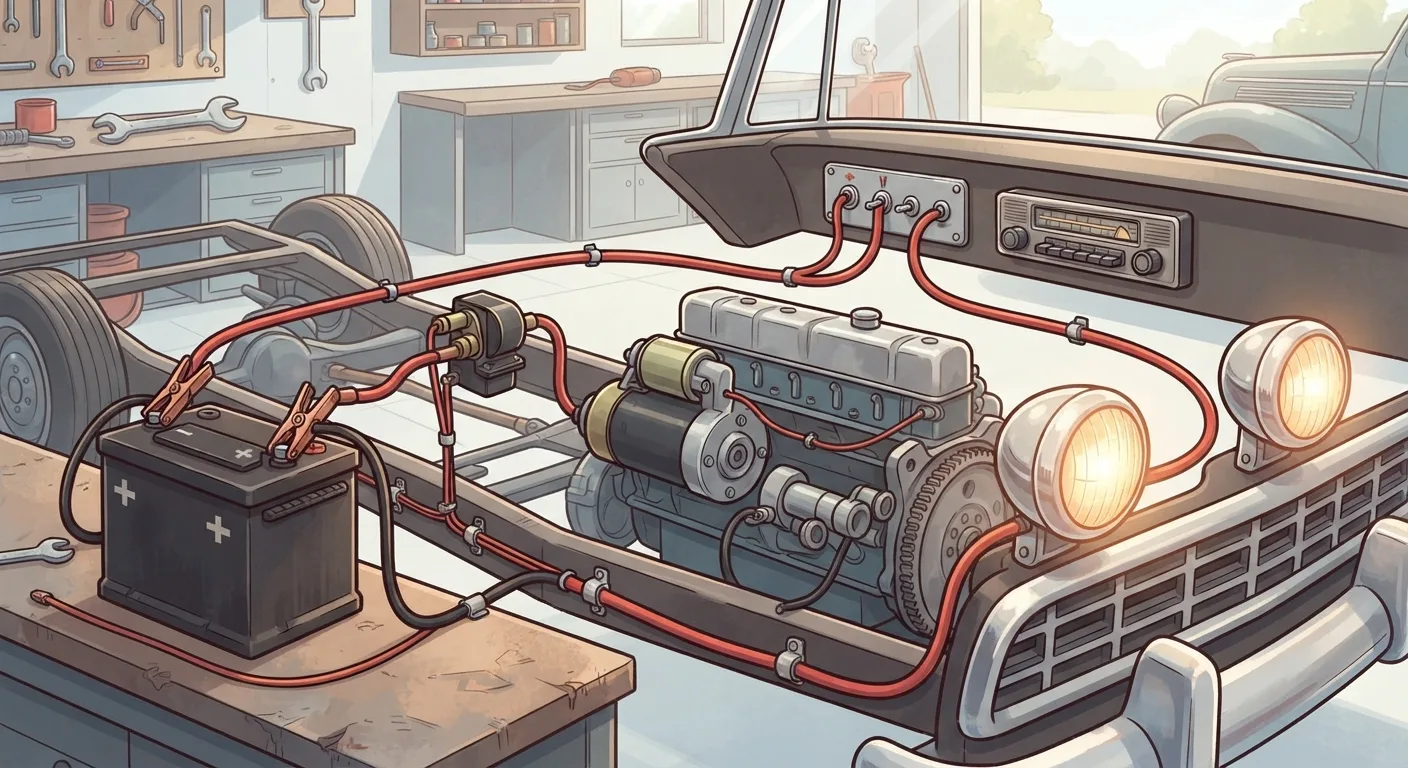
The 12-volt electrical system has been the backbone of cars since the 1950s. Back then, a car needed power for headlights, a radio, and an electric starter: simple stuff. Twelve volts was plenty.
Fast-forward to today, and your car is basically a smartphone on wheels. It’s packed with ADAS sensors, infotainment screens, electric seat motors, heated windows, and even steer-by-wire and brake-by-wire systems. All of these gadgets are power-hungry, and the old 12V system is starting to feel the strain.
The Core Problem: Power = Voltage × Current
Here’s the simple physics that explains the entire 12V vs. 48V debate.
Power (watts) = Voltage (volts) × Current (amps).
If you need a certain amount of power, you can either use high voltage and low current or low voltage and high current. High current is the villain here: it creates heat, requires thick, heavy copper wires, and wastes energy as resistive losses.
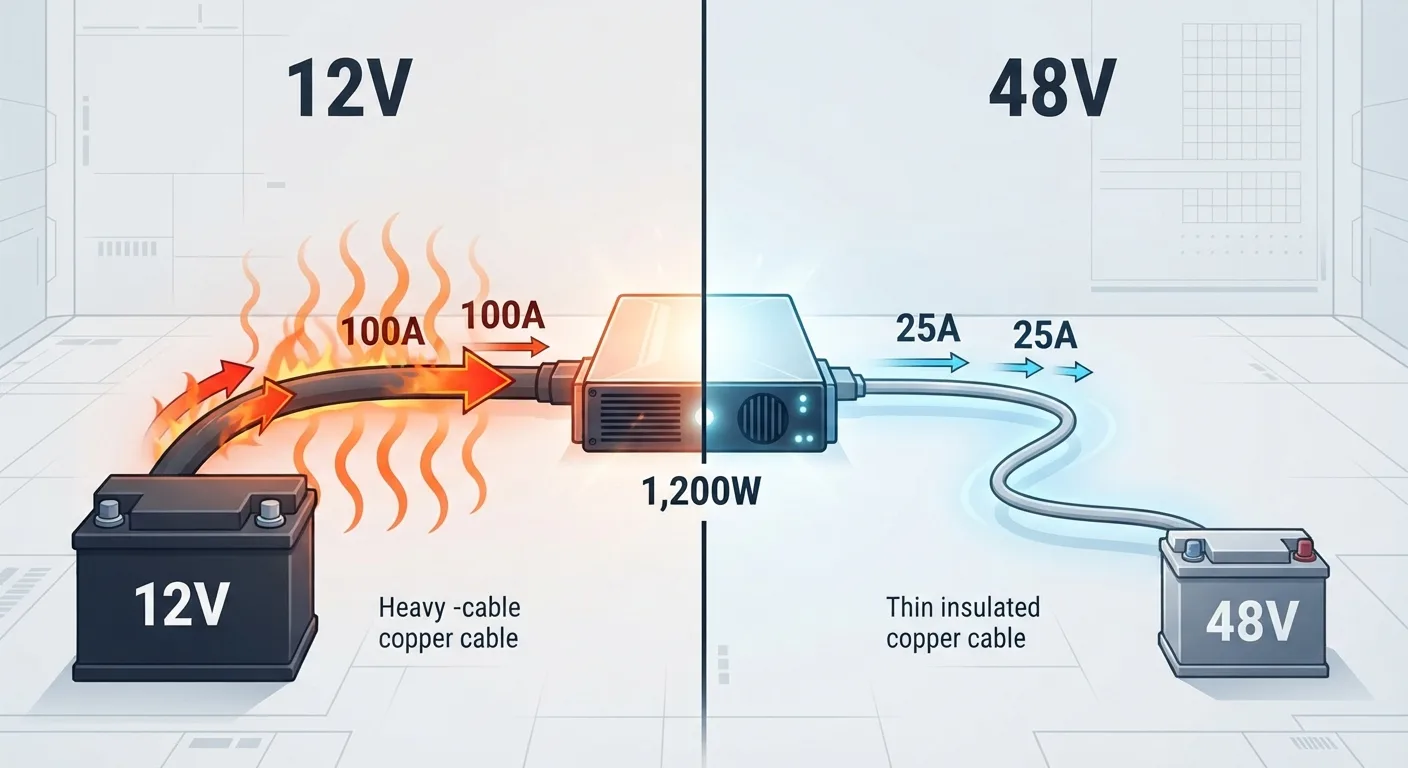
Let’s make it concrete. Delivering 1,200 watts of power:
- At 12V: You need 100 amps of current.
- At 48V: You need only 25 amps.
That’s a 4× reduction in current for the exact same power. And the benefits cascade from there.
The 48V Superpowers: What Changes When You Quadruple the Voltage
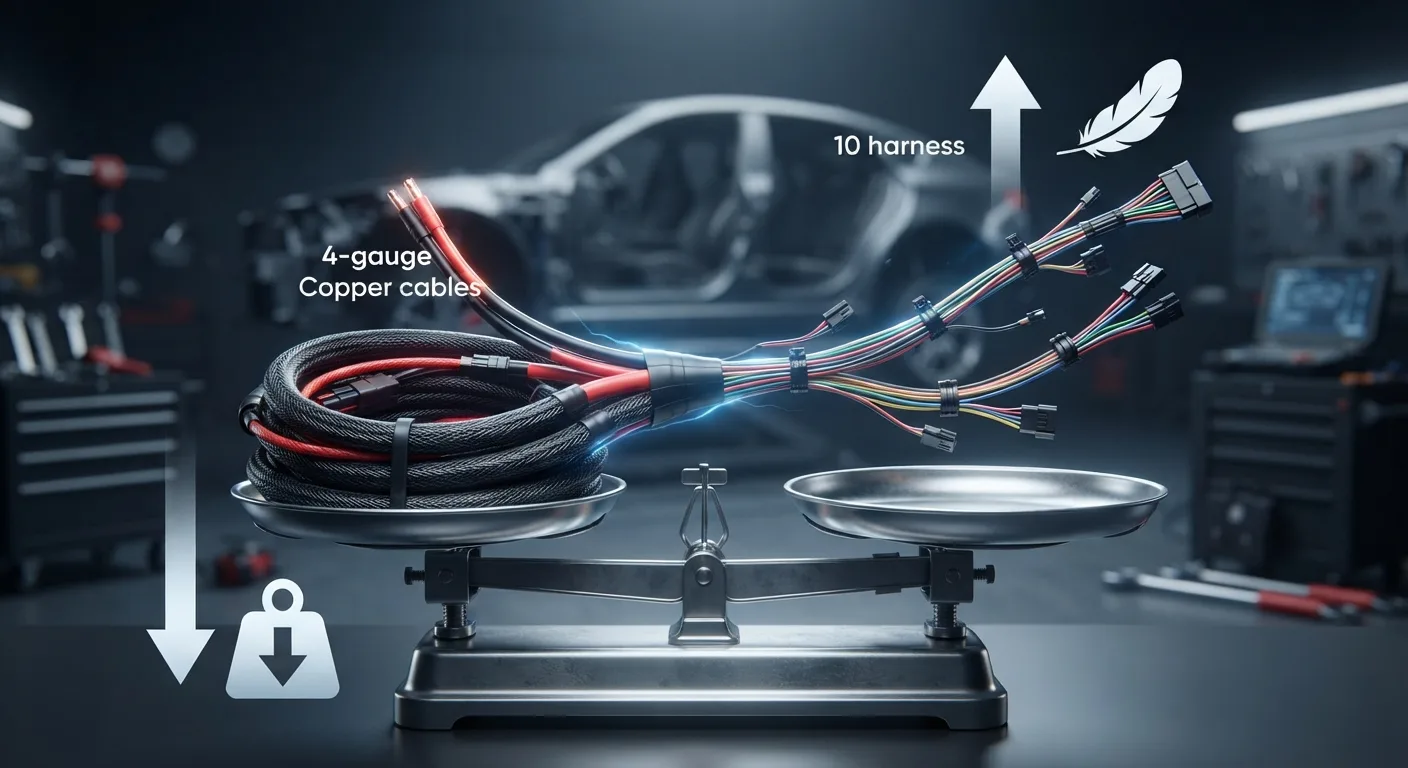
1. Your Wiring Harness Goes on a Diet
Lower current means you can use much thinner, lighter wires. In fact, the main power cables can shrink from a beefy 4-gauge wire to a slim 10-gauge wire. That alone cuts copper content by over 70% and wire harness weight by up to 80%, saving anywhere from 5 to 10 kg (11 to 22 lbs) depending on the vehicle.
For automakers, this is a triple win: lighter, easier to assemble, and cheaper.
2. Efficiency Skyrockets, Heat Plummets
Resistive power losses (the energy wasted as heat in wires) drop up to 16 times in a 48V system compared to 12V. That means more of the power you generate actually reaches the components that need it. Motors also run cooler and can be downsized, because they draw less current for the same output.
3. 48V Is the “Goldilocks” Voltage for Safety
This is a big one. 48V sits just below the 60V threshold that’s generally recognized as “high voltage” for shock hazards. So you get the efficiency benefits of higher voltage without the complex, expensive safety requirements of a 200 to 400V full-hybrid or EV battery system.
In other words: 48V is powerful, but it won’t bite.
The Real Reason 48V Is Everywhere: Mild Hybrids
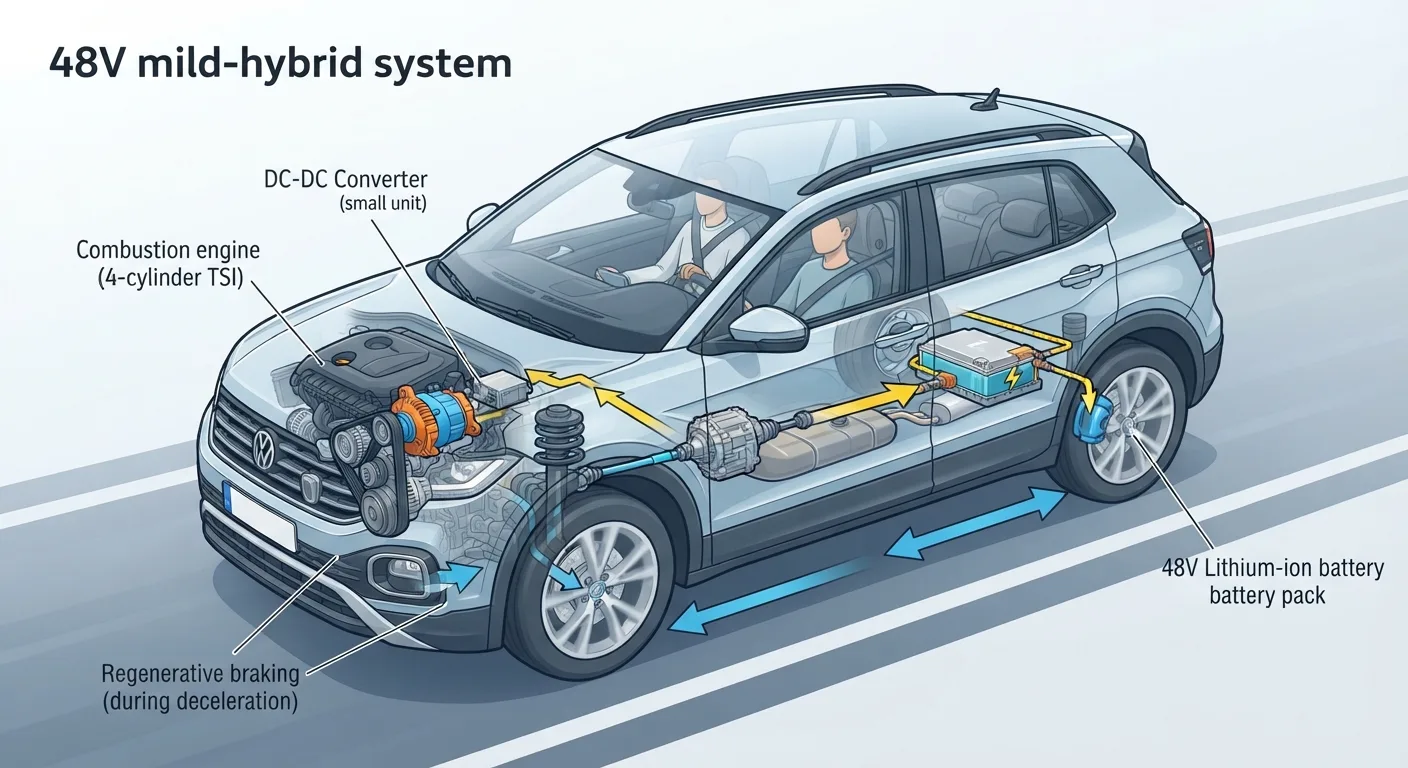
The biggest practical application of 48V today is the mild hybrid electric vehicle (MHEV). Think of it as hybrid-lite.
A 48V mild hybrid typically adds:
- A small 48V battery (often under 1 kWh)
- A belt-driven starter-generator or integrated motor
- A DC-DC converter to keep the 12V system alive for legacy components
What does it actually do?
- Start-stop: Shuts off the engine at red lights and restarts it smoothly.
- Regenerative braking: Captures energy that would otherwise be lost as heat and stores it in the 48V battery.
- Torque assist: Gives the engine a little electric shove during acceleration, improving responsiveness and allowing a smaller engine.
The payoff? A 48V mild hybrid can deliver around two-thirds of the benefits of a full hybrid at roughly one-third the cost. Fuel economy improvements are typically in the 8 to 15% range, with CO₂ reductions of up to 15%.
The Bigger Picture: 48V Is No Longer Just a “Fuel-Saver”
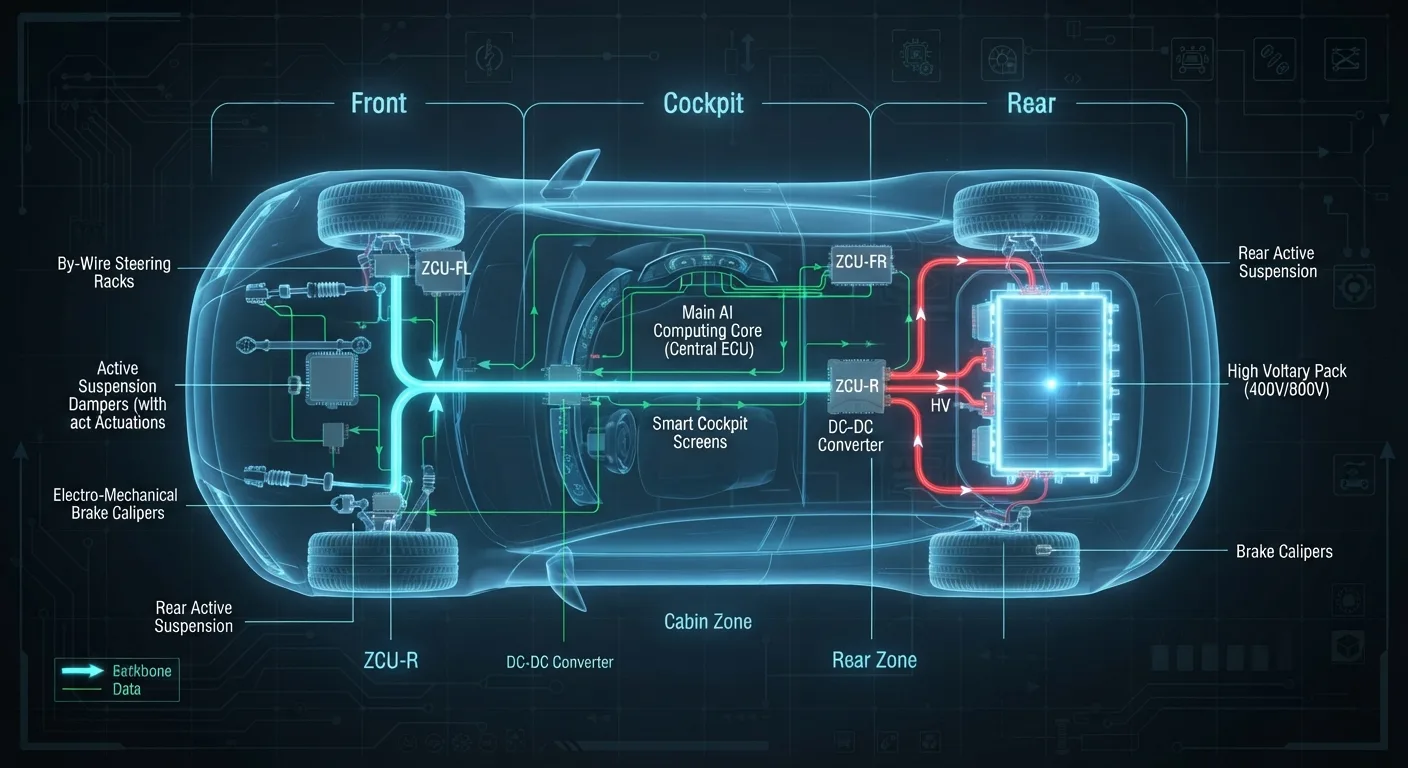
Here’s where the story gets really interesting, and a little viral.
For years, 48V was dismissed as a “transition technology”: a stopgap for automakers trying to meet emissions rules without going full EV. But something shifted. As cars get smarter and more software-defined, the 12V system has hit a hard power ceiling.
Modern intelligent vehicles need juice for:
- Onboard computing platforms and AI chips
- Smart cockpits with massive screens
- By-wire steering and braking
- Active suspension systems
These loads are pushing 12V to its absolute limits. In response, 48V has been promoted from “fuel-saving sidekick” to the low-voltage backbone of next-generation electrical architectures.
The proof is on the road:
- Tesla’s Cybertruck uses a full 48V low-voltage system.
- Ford has confirmed that its affordable electric pickup, due in 2027, will use a 48V system with a zonal architecture, cutting about 1,200 meters of wiring and 10 kg of weight.
- Bosch and Chery signed a deal in 2026 to mass-produce a 48V vehicle architecture capable of delivering up to 15 kW of low-voltage power while shedding over 10 kg of system weight.
- Nio is using 48V for its active suspension, and Leapmotor has announced an all-48V vehicle platform.
Wait, What About the Downsides of 48V?
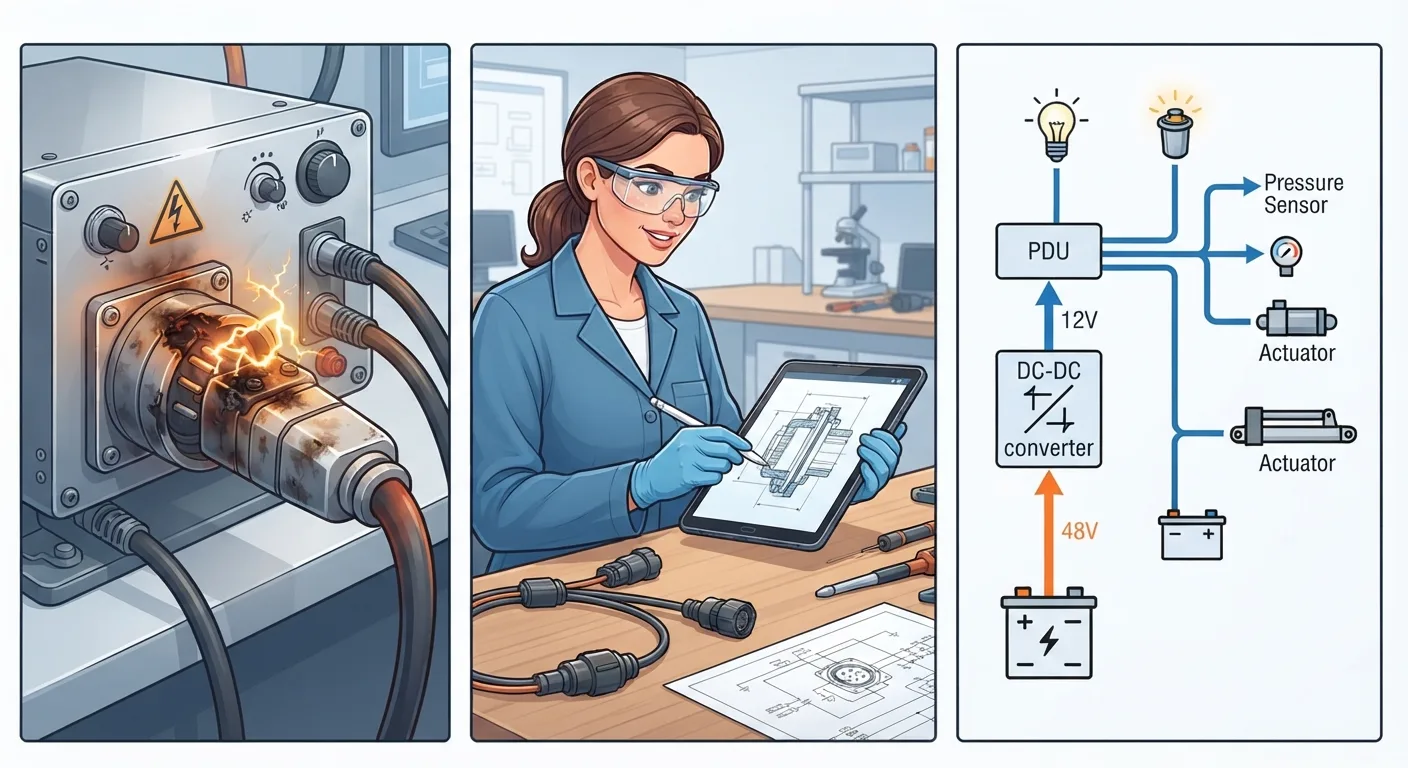
No technology is perfect, and 48V has its quirks, mostly for the engineers, not for you.
The Arc Flash Challenge
Higher voltage means that if a connection is broken or shorted, the resulting electrical arc carries more energy and can last longer than at 12V. This can damage connectors and, in extreme cases, pose a fire risk. Engineers must design connectors with greater creepage and clearance distances and robust sealing to mitigate this.
It’s Not a Clean Swap
You can’t just replace a 12V battery with a 48V one and call it a day. Many low-power devices (infotainment, lighting, legacy sensors) will stay on 12V because their wire sizes are driven by mechanical durability, not electrical load. That’s why most 48V vehicles use a multi-voltage architecture: a 48V backbone for the heavy lifting, with a DC-DC converter feeding a 12V bus for the old guard.
In short: 12V isn’t dying. It’s becoming the trusted sidekick.
The Friendly Bottom Line: Should You Care?
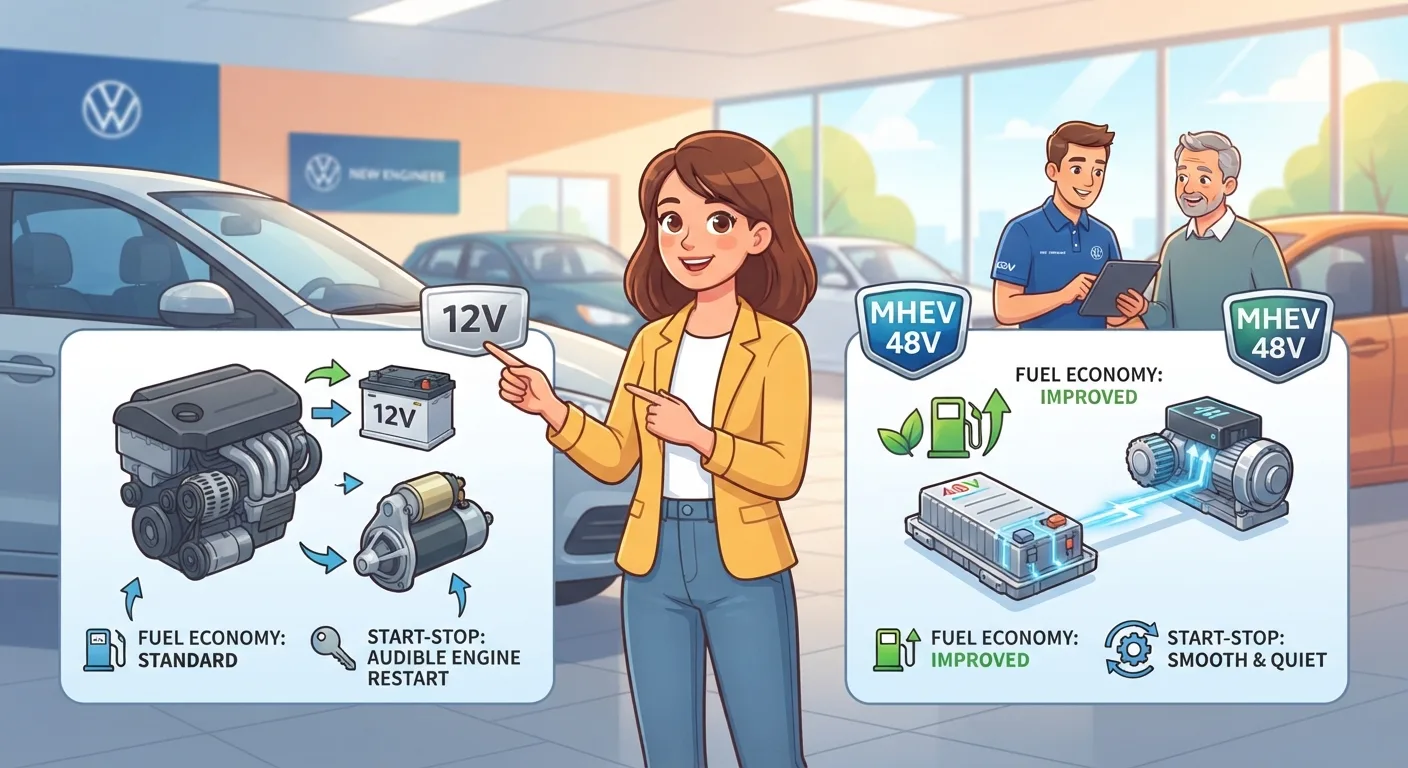
If you’re shopping for a car: A 48V mild hybrid is a smart, low-cost way to get better fuel economy and smoother stop-start without paying the full-hybrid premium. You’ll see it badged as “MHEV,” “48V,” or “EQ Boost” depending on the brand.
If you’re an engineer or tech nerd: 48V is the most exciting thing to happen to the low-voltage side of the car in decades. It unlocks power budgets that were simply impossible on 12V, and it’s the enabling architecture for the software-defined vehicle.
If you just like knowing things: The next time someone says “my car is 12-volt,” you can smile and say, “Yeah, the small stuff. But the future is 48.”
TL;DR (For the Scrollers)
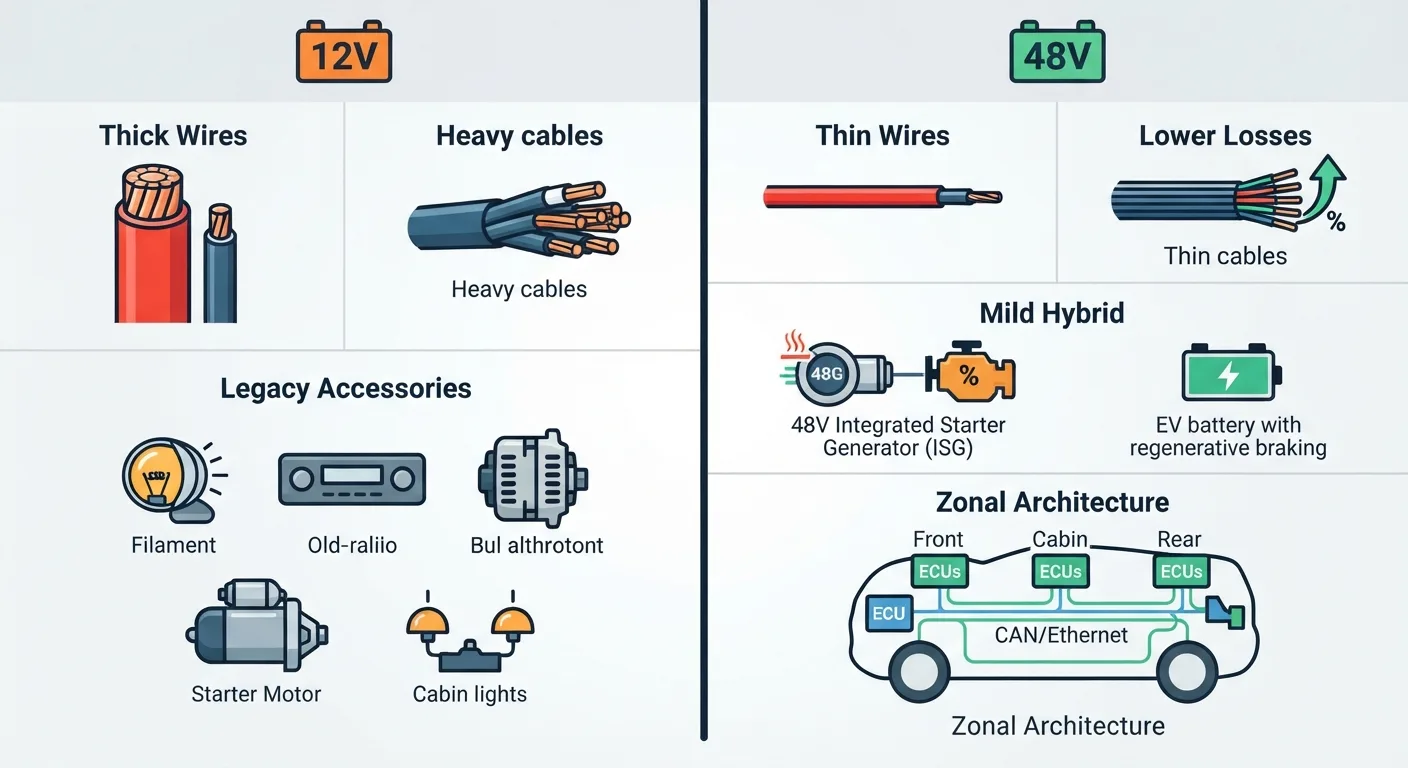
| Feature | 12V System | 48V System |
|---|---|---|
| Current for 1,200W | 100 A | 25 A |
| Wiring weight | Heavy (4-gauge) | Up to 80% lighter (10-gauge) |
| Power losses | Higher | Up to 16× lower |
| Safety classification | Extra-low voltage | Still below 60V shock threshold |
| Primary role | Legacy accessories, infotainment | High-power loads, mild hybrids, zonal architecture |
| Verdict | Staying for the small stuff | The new low-voltage backbone |
Bottom line: 48V isn’t a gimmick. It’s the quiet revolution that’s making your next car lighter, more efficient, and ready for the software-defined future, all without asking you to plug in. And honestly? That’s pretty electrifying.